

Unless you have spent significant time traversing the jagged edges of the English coastline, you might never have noticed the weathered concrete shapes half-buried in the dunes or perched precariously on eroding cliff tops. To the uninitiated, these structures appear as quiet disruptions in the landscape. Although, these World War II Pillboxes represent a profound architectural genre: a perverse instrument of defence where every angle, material choice, and internal dimension was dictated by the singular necessity of survival (Historic England, 2023).

(Pillbox, Fraisthorpe Beach, near Barmston, East Yorkshire. © Historic England Archive)
This exploration is informed by a recent lecture series I am attending, specifically a session delivered by Jim Sallis regarding "Heritage Impact Assessments and Understanding Significance". Sallis (2026) emphasises that the foundation of any Conservation Management Plan (CMP) is an accurate record of the site and its condition. Without this precise documentation, we risk losing the cultural heritage value of spaces that, while visually stark, provide a vital physical record of 20th-century defensive thinking. By treating the pillbox as a significant architectural object, we can apply a rigorous framework to understand why these "shared resources" must be sustained for future generations (Historic England, 2008).
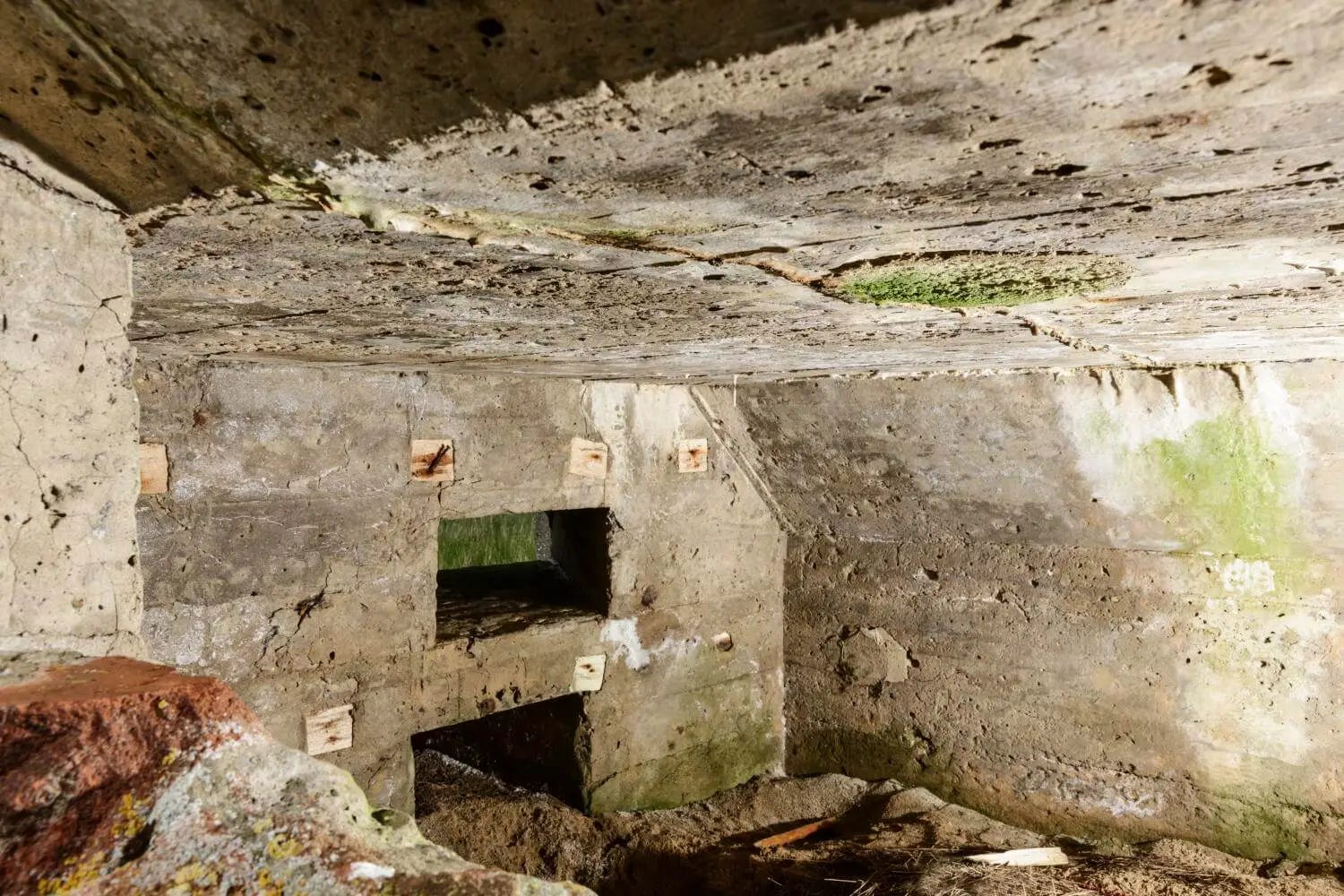
(The inside of a pillbox, Skidbrooke, East Lindsey, Lincolnshire. © Historic England Archive)
The Development and Proliferation of the Defensive Blockhouse
A Pillbox is defined as a small, fortified structure or "blockhouse," typically constructed from concrete and strategically camouflaged to conceal its occupants from enemy surveillance (Historic England, 2023). The term, which first appeared in print on the front page of The Times on August 2, 1917, refers to the distinctive geometries (often round, square, or hexagonal) that mirrored the shapes of early 20th-century medicine containers (Historic England, 2023).
While the architectural concept originated with the German army on the Western Front during the First World War, it was rapidly adopted for English coastal defence as the threat of invasion increased in regions such as the Humber Estuary and the coast of Norfolk (Historic England, 2023). Early survivors, such as the 1917 Grade II listed structure at Auburn Farm, East Yorkshire, demonstrate the pioneering use of Western Front engineering, specifically reinforced concrete, to withstand repeated gunfire (Historic England, 2023).
The most significant proliferation of these structures occurred during the Second World War. Following the evacuation of Allied troops from Dunkirk in May 1940, the English coastline was viewed as highly vulnerable, leading to an urgent fortification effort (Historic England, 2023). In June 1940, General Paget, Chief of Staff to the Commander-in-Chief Home Forces, submitted a national anti-invasion plan to the War Cabinet stressing the importance of these defenses (Historic England, 2023). This strategy established a network of approximately 28,000 “stops and strong-points” across beaches and strategic inland locations, such as canals and hills, designed to prevent the enemy from “running riot and tearing the guts out of the country” (Historic England, 2023).
Although construction ceased by 1943 as the threat of invasion subsided, only about 25% of these wartime blockhouses remain in the landscape today, standing as fragmented physical records of a past national crisis (Historic England, 2023).

(Grade II listed pillbox, Auburn Farm, near Barmston, East Yorkshire. © Historic England Archive)
The Assessment of Significance
The primary challenge in conserving coastal pillboxes is the ease with which their cultural heritage value can be overlooked or lost when they are not viewed within a structured heritage framework that recognises their evidential and historical significance.
According to the criteria set out in BS 7913:2013, heritage value is generally assessed through aesthetic, communal, evidential, and historical lenses (Sallis, 2026). The pillbox at Auburn Farm, East Yorkshire (1917), serves as a primary example; it is considered one of the earliest of its kind in England, utilising reinforced concrete techniques developed on the Western Front in 1916 (Historic England, 2023).
“BS 7913:2013 is the British Standard guide for the conservation of historic buildings and heritage structures. It provides essential, best-practice principles for inspecting, maintaining, and altering historic buildings, offering guidance on managing heritage significance, repairing defects like dampness, and navigating conservation, particularly for those working on traditional or protected structures.”
In the context of Sallis’s lecture, understanding significance is vital as a result it determines how we manage change. For a structure like the Auburn Farm pillbox, its significance is derived from its rarity and its adaptation, having been reused during the Second World War with new gun holes to improve firing points (Historic England, 2023). When we fail to document these sites, we lose the precise documentation required to maintain authenticity (Sallis, 2026). Once this physical fabric is lost (as seen at Skipsea and Happisburgh, where structures have fallen onto the beach due to coastal erosion) the memory of the past it facilitates is lost forever (Historic England, 2023).

(Scheduled pillbox to the right of the gatehouse at Dunstanburgh Castle, Craster, Northumberland. © Historic England Archive)
The Geometry of Concealment
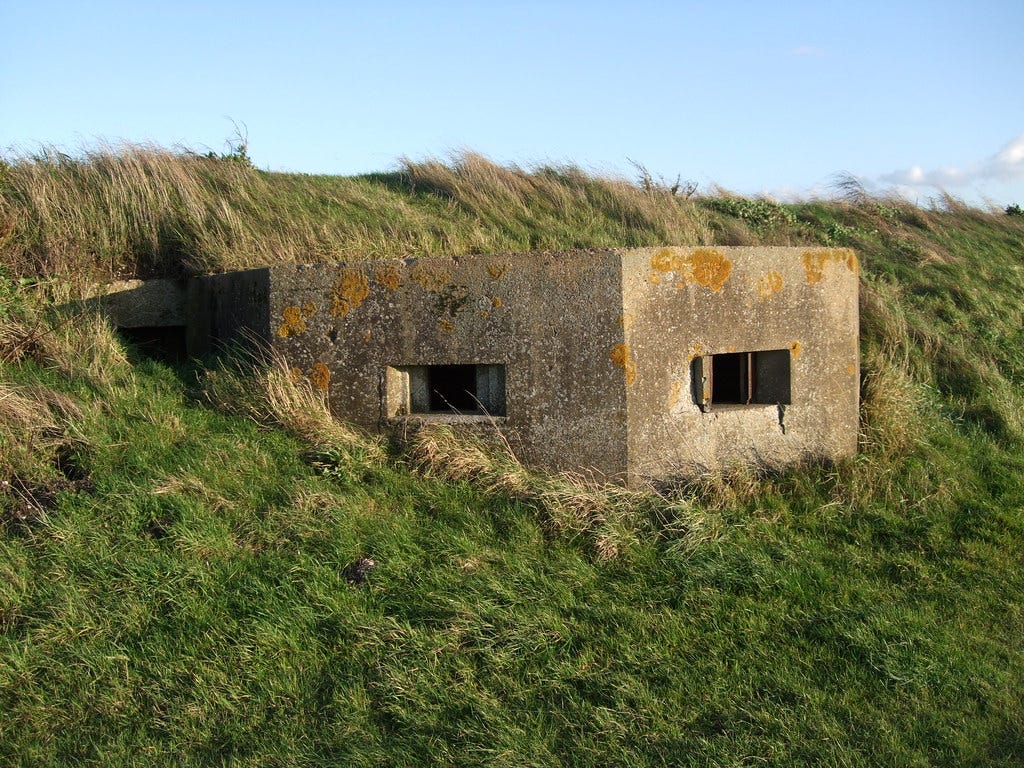
The architectural form of the pillbox is a literal manifestation of its defensive purpose, designed to blend into the landscape while providing maximum fields of fire. The term "pillbox" itself was popularised because their compact, geometric designs were often compared to early 20th-century medicine containers (Historic England, 2023). While many followed standard concrete designs, others, like the Grade II listed structure at Bleak Hey Nook, utilised a dry stone wall exterior and turf-covered roof to look like a "typical agricultural vernacular building" (Historic England, 2023). This camouflage was essential to hide occupants from enemy view while they utilised "loopholes" (small slits in the wall) to discharge firearms (Historic England, 2023).
The design of these structures represents a "non-contact" relationship with the landscape, where the building must observe without being observed. At Bicester Aerodrome, the octagonal design formed part of a series of fixed defensive points protecting the inner core of the air base (Historic England, 2023). The group value of these structures (the way in which they are arranged as mutually supporting strong points) is of particular interest as an illustration of defensive thinking (Historic England, 2023). The architecture is not about traditional beauty, but rather about a spatial script of surveillance and resistance.
Material Integrity in the Anti-Invasion Blockhouse
The architectural integrity of the pillbox is a direct result of its defensive requirements, where shape, form, and materiality were fused to create a ‘shell-proof’ enclosure capable of withstanding modern ordnance.
While commonly associated with a "standard" hexagonal or square concrete design, the form of the pillbox was frequently adapted to suit its specific strategic environment. For instance, the Grade II listed structure at Bleak Hey Nook utilised a dry stone wall exterior and a turf-covered roof to mimic local agricultural vernacular, camouflaging it from enemy view (Historic England, 2023). Conversely, the octagonal designs at Bicester Aerodrome were constructed from brick, concrete, and earth to protect against paratroopers and aerial surveillance (Historic England, 2023). Most structures featured "loopholes" (small horizontal slits) where designed specifically to provide a protected vantage point for discharging firearms while maintaining the structural thickness of the walls (Historic England, 2023).
The evolution of the pillbox's materiality reflects an escalating need for structural resistance. Early First World War examples along the East Riding coast were often "relatively insubstantial" and barely "bullet-proof" (Historic England, 2023). Although, by the Second World War, the necessity of a national "anti-invasion plan" led to the development of "substantial shell-proof" blockhouses (Historic England, 2023). These structures functioned as part of a wider network of "stops and strong-points" intended to prevent enemy forces from "running riot" across the interior landscape (Historic England, 2023). The use of in-situ poured concrete and steel reinforcement was not merely a construction choice but a strategic imperative; at Auburn Farm, the wall and roof thickness were specifically engineered to resist repeated exposure to gunfire (Historic England, 2023).
Conclusively, the material integrity of the blockhouse is found in this synergy between form and purpose. Whether using a concrete raft floor to prevent sinking in shifting sands or utilising nails for camouflage netting, the pillbox remains a physical testament to a moment when architecture was reduced to the essential logic of survival (Historic England, 2023).
The Inhabitant’s Experience
From an architectural and human perspective, the interior of a pillbox represents an extreme state of physical and psychological disjunction, defined by sensory deprivation and prolonged discomfort. Depending on the specific design, such as the hexagonal Type 22 or the larger Type 24, these blockhouses were intended to be occupied by squads ranging from one to ten men (Historic England, 2023). Within these concrete shells, occupants were subjected to very cramped conditions and low ceilings while observing the external landscape through rectangular loopholes (Historic England, 2023).
Beyond the archival evidence, the reality of inhabiting these spaces was defined by a harsh environment that was perpetually cold, damp, and dark (Historic England, 2023). Concrete is a thermal mass that holds moisture, the walls would often sweat, creating a humid, chilling atmosphere that offered no respite from the coastal elements. This environment often led to a “bunker mentality", a psychological struggle where the individual feels simultaneously protected by feet of reinforced concrete and yet dangerously trapped. The spatial experience is one of total restriction; with the only connection to the outside world is a sliver of light from the loophole, turning the landscape into a filtered, two-dimensional image. This non-coincidence between the rigid geometry and the human need for light and movement creates an intense psychological strain, where the smell of damp air and the sound of the sea are amplified within the echoing chamber.
This intense sensory reality is a critical part of the structure’s communal and historical value, providing a powerful and tangible connection to the lived experience of the 1940s anti-invasion plan (Historic England, 2023).

(A fallen pillbox, Happisburgh, Norfolk. © Historic England Archive)
Conclusion | The CMP as an Ethical Document
The pillboxes of the English Coastline represent a unique architectural disjunction where the rationalised geometry of defence meets the visceral reality of physical confinement. As discussed in Sallis’s lecture, these structures are significant precisely because they are a shared resource that allows us to participate in sustaining our collective historical environment. Far from being static relics, their materiality stands as a sincere record of a period when architecture was reduced to the essential requirements of survival. Whether taking the form of a hexagonal blockhouse at Tolman Point or a stone-clad vernacular imitation at Bleak Hey Nook, these original forms illustrate the sophisticated development of reinforced concrete for infantry defence.
References
Historic England. (2008) Conservation Principles, Policies and Guidance. London: Historic England
Historic England. (2023) A Brief Introduction to Military Pillboxes. The Historic England Blog
Sallis, J. (2026) Heritage Impact Assessments and Understanding Significance. [Lecture Notes]. 18th February 2026